
Catching cashflow trouble three weeks earlier.
2026-05-19 · 10 min read · by the thola team
It's 9:47 PM on a Tuesday and Rohan is looking at his runway sheet.
He runs a 9-person B2B SaaS company out of Indiranagar. Eighteen months in, ₹4.2 crore ARR, mostly annual contracts, two engineers and a designer added in February. The runway sheet is a Google Sheet his old co-founder built in 2024 and has been updated every Sunday night since. The tab is called "Cash v6 FINAL USE THIS ONE."
Tonight the sheet says he has 11 months of runway. He believes it.
He's wrong. He actually has six.
What happened is this: in March, his largest customer — a 400-person logistics firm in Mumbai — quietly stopped paying. They didn't dispute the invoice. They didn't cancel. They just slid the payment from the agreed Net-30 to whatever-the-accounts-team-feels-like. ₹14 lakh got pushed from April to "probably May." Then in April, a smaller customer did the same thing with ₹3 lakh. Then in May, a third one with ₹6 lakh.
Rohan books revenue on the invoice date. The runway sheet calculates burn against booked revenue. By the time the cash actually doesn't show up in the bank, his runway sheet has been telling him a comforting lie for three weeks.
This is the most common cash mistake we see at thola. It is not "we spent too much." It is the gap between what you've billed and what you've collected, in a country where 45-day payment terms are routine and 90-day stretches are not unusual.
The numbers, because they matter
If your business sells to other businesses in India, here is the cash-flow physics you are up against:
- The MSMED Act mandates 45-day payment terms. Compliance is patchy. Receivables stuck behind corporate and government buyers routinely run 60–120 days.
- ₹530 billion is the conservative estimate of the MSME credit gap. Only 14% of India's 64 million MSMEs have any formal credit access.
- 82% of surveyed MSMEs flag GST compliance cost as a significant burden. 59% specifically report blocked working capital because they pay GST on the invoice date, before the buyer has paid them. You owe the government 18% of money you haven't yet received.
- 73% of MSMEs say they struggle to optimise cash flow at peak season, when Diwali alone accounts for 30–40% of annual revenue for many sectors.
That stack — collections lag plus GST front-loading plus festival lumpiness plus thin credit access — is the cash crisis the runway sheet doesn't catch. The runway sheet treats invoiced revenue as money in the bank. It isn't.
What "real-time cash" actually means
This is where the marketing gets thick, so let's be specific.
"Real-time cashflow" in most products means: a chart that updates when you manually enter a new bank balance. That isn't real-time, that's a manual chart. The thola version is the opposite — we read your collections, invoices, payment attempts, and project budgets every time something changes, and we show you the position the moment it shifts.
Here is what that looks like for Rohan, on the imaginary alternate timeline where he had thola from January.
On March 12, his Mumbai customer's ₹14 lakh invoice goes overdue by one day. thola flags it amber on his weekly Finance brief. He notices, doesn't act — first overdue from this customer ever, probably a one-week thing.
On March 18, it's still unpaid. thola escalates to red. The Finance agent drafts a polite collection email in Rohan's tone ("Hi Suresh — just checking on Inv #2403, you're 7 days past due. Let me know if there's anything blocking it on your end."). Rohan reads it, tweaks one line, sends.
On March 22, Suresh replies — accounts is sitting on three vendor invoices waiting for the CFO to sign. Realistic ETA: April 10.
On March 23, thola updates Rohan's projected cash position. The ₹14 lakh slides 21 days into the future. His runway, on the screen in front of him, drops from 11 months to 9.7 months. Three weeks before the bank reconciliation would have caught it.
That is what "earlier" actually means. Not a smarter forecast. A faster signal.
How thola sees your real cash
thola's Finance module looks at five things, every time any of them change:
- Invoices issued vs. invoices paid. Per customer, per project, per month. Aging buckets.
- Payment attempts. When a customer started a UPI transfer, when it failed, when it succeeded. Not just final state.
- Project budget vs. actual. For project-based businesses, this is where margin dies. We watch line-by-line.
- Recurring expenses. Payroll runs, vendor commits, statutory due dates.
- GST liability accrual. What you owe at month-end against what you've collected against those same invoices.
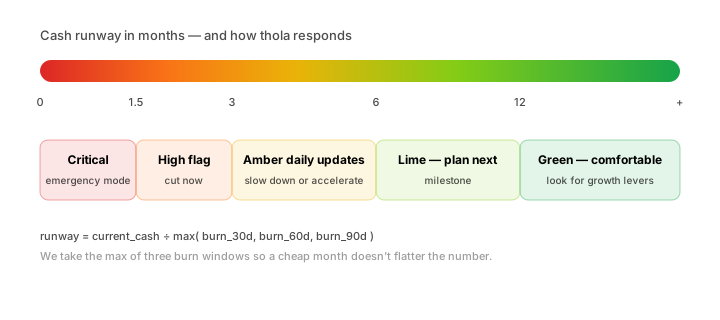
The five together produce one number: your projected cash position for each of the next 90 days. Not "estimated runway in months" — that's the headline number, fine. The useful version is the day-by-day curve, because it tells you which week the trouble starts.
What changes for the founder
Here's the smaller behavioural shift that actually matters, and that nobody talks about.
Without thola, Rohan checks cash on Sunday night. It is a private ritual involving guilt, two cups of coffee, and a sinking feeling. He doesn't share the sheet. His team doesn't see it.
With thola, Rohan opens his morning brief at 9 AM and the Finance agent has already told him: "Cash position is stable. Receivables aging is normal. One thing to know — ABC Logistics is now 9 days late on their April invoice; this is the second time in two months. Want me to draft a reminder?"
The dread evaporates. Not because the cash situation is better — it might be worse — but because the situation is visible, and there's an action attached to it.
This is the deeper thing the dashboard-first generation of finance tools never got right. A founder doesn't want a chart. A founder wants a sentence that ends in a verb.
A short story about what happens at Diwali
A second customer, because the Diwali pattern deserves its own minute.
Murugan runs a 6-store FMCG distributor in Coimbatore. Diwali is 38% of his annual revenue. Every year, he borrows in August to build stock for the October surge. Every year, he stares at his bank balance through September and prays.
What killed him in 2024 was not that the stock didn't sell — it did, mostly. It was that two of his largest accounts paid him 70 days late on the festive invoices. He had borrowed ₹38 lakh on the assumption of a 40-day collection cycle. The 70-day cycle meant he was personally fronting payroll in November and December out of his own savings. He had no idea that was happening until the bank balance dropped below ₹2 lakh on November 27.
Two things would have changed that, with the kind of visibility thola provides:
- He would have known on November 1 that the collection cycle had slipped to 70 days, not on November 27 when the bank account told him.
- The Finance agent would have drafted collection escalations for the two accounts on Oct 20, Oct 27, and Nov 3 — the three calls he didn't make because he was knee-deep in store ops.
The takeaway is not "the agent would have collected the money." Maybe it would have, maybe it wouldn't. The takeaway is that the founder would have been making decisions on real numbers four weeks earlier, which is the entire difference between a Diwali that works and a Diwali that hollows out your savings.
The 5 things you can see in your first week
If you connect your bank, your invoices, and your project budgets to thola — about a 20-minute setup — here is what shows up on day one:
- Today's projected cash position, and the curve for the next 60 days.
- Aging receivables in buckets (0–30, 31–60, 61–90, 90+), per customer.
- The three accounts most likely to slip, based on their own past payment history.
- GST liability vs. collected — how much of next month's GST is "real money you have" vs. "money you haven't collected yet."
- The week the runway hits 6 months, if your current trajectory holds.
That last number is the one founders tell us they wish they'd seen earlier. It is the most useful number on the page. It is the one nobody's spreadsheet calculates honestly, because honest spreadsheets are uncomfortable.
What we're not pretending to do
A few honest limits:
- We don't yet do probabilistic forecasting from uncertain pipelines. If your business depends heavily on deals that may or may not close, our forecast assumes only booked revenue. The probabilistic version is on the roadmap.
- e-Invoice (GST EINV) auto-generation is not yet shipped. We track GST liability accurately; we don't yet auto-file. You still need your CA.
- We don't replace your accountant. The Finance agent is excellent at cashflow and reasonable at anomaly detection. It is not GST counsel and won't pretend to be.
- Auto-aging dunning — where the system itself decides when to chase — is on the way, but not on by default. Today, we draft, you send.
We are deliberately conservative about money. You should be too.
Get started
Connect a bank account and a couple of invoices in the Finance setup guide. The free tier handles up to ₹50 lakh of monthly billed revenue and full receivables tracking. Most 6-to-15 person SaaS companies run their entire finance posture on it.
The next time someone asks you how much runway you have, you'll have an answer that isn't a guess.
Related posts
Cash control that fits your shop.
A solo owner, a family helper, and a four-counter supermarket need three different kinds of cash discipline. Here's how one setting scales across all of them — and why the day-close should reassure you, not accuse anyone.
The Monday morning that doesn't start with a spreadsheet.
Fourteen tabs of 'Final v3 USE THIS ONE'. Sunday-night dread. Three days of context-switching to read your own business. Here's what changes when you fire all of that.
The 9-second bill at the kirana counter.
It is Friday evening, the queue is 14 people deep, and your biller is typing item names manually. Here is what shortening that one transaction does to your weekend.