
What changes when your shop floor finally speaks Tamil.
2026-05-19 · 10 min read · by the thola team
The first time we sat with Suresh, the production manager of a small textile unit outside Coimbatore, he showed us his phone.
His HRMS app was in English. His WhatsApp was in Tamil. His company's stock management tool was in English. His personal banking app — the one he uses every day — was in Tamil. The maintenance log in his factory was a paper notebook, in Tamil, with English numbers.
"Sir," he said, in Tamil, to his founder, "I can use this. But the boys on the floor cannot. They open the app, they see English, they close it. Then they tell me what they did and I type it in for them."
The founder, Karthik, who built the business from scratch and now employs 31 people in two units, nodded. He has been the integration layer between his English-only software and his Tamil-only floor for three years. He estimates this takes him at least an hour every single day, which is to say, about 250 hours a year, which is six full work-weeks, every year, that he spends being a human translation layer.
This is the most common, most invisible form of digital-adoption resistance in India. It isn't that the team doesn't want the software. It's that the software doesn't speak their language. And nobody at the founder's level is measuring it.
The numbers, the same ones nobody quotes
Some research that's worth sitting with:
- 26% of kirana owners report difficulty learning new tools. 16% cite cost. The other 58% — the ones who tried and quit — most often quit because the tool was in a language their staff didn't operate in.
- Multilingual training improves employee retention by 34%. Not productivity. Retention. People stay at jobs where the systems they have to use respect their language.
- Office staff manage in English. Factory floors, field sales, multi-branch staff don't. Hindi + 2–3 regional languages cover most Indian workforces, but the modal HRMS / stock / CRM tool in this market ships English-first and adds languages "in the next quarter."
- Vernacular customer communication lowers bounce rates and builds trust in Tier-2 and Tier-3 markets. When you send a Kannada invoice instead of an English one, you get paid faster. We have customers who can show you the data.
We built thola in six languages from the first commit — English, Tamil, Telugu, Kannada, Malayalam, and Hindi — for the reason these numbers point at. Not because it makes for nice marketing. Because the alternative is a tool that 60% of your team will not use.
What "in six languages" actually means
There is a real difference between "the menu translates to Tamil" and "the system works in Tamil." Many tools claim the first. The second is a much bigger commitment. Here's what we mean by it:
1. The UI menus, every word
Every label, button, error message, and tooltip is translated for all six locales. Not by Google Translate. By humans who use the product in that language, with feedback loops with our customers. Suresh did our Tamil review for three weeks. Reema in Hyderabad did the Telugu one.
2. The help content
In-app help, walkthroughs, troubleshooting articles — all in the user's language. When Suresh's new hire on the shop floor opens the leave-request screen and doesn't know what "regularisation" means, the help text explains it in Tamil, with an example his uncle would understand.
3. The AI responses
The assistant — the chat-based agent that runs across the product — responds in the user's chosen language. If Suresh types in Tamil, the answer comes back in Tamil. If he types in English (he sometimes does, mid-task), the answer comes back in English. He doesn't have to pick.
4. The cross-language messaging
This one is the part most teams haven't seen anywhere else.
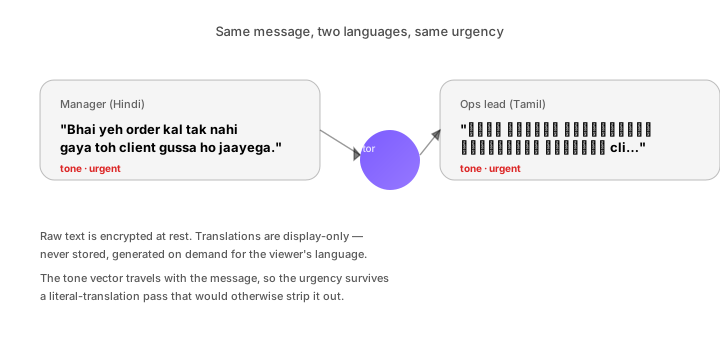
Karthik wants to send Suresh a task: "Get the dyeing line cleaned today, the new order is starting tomorrow." He types this in casual Tamil, because that's how he talks to Suresh. Suresh's helper on the floor — a 19-year-old from a village near Tirunelveli — does not read Tamil text comfortably. He reads Telugu. (His family moved.) When the task lands in his queue, it's in Telugu. And not in the stiff, formal Telugu that translation engines tend to produce — it's in Karthik's voice, casual and warm, as Karthik would have written it if Karthik spoke Telugu.
We call this tone-preserving cross-language messaging. It's the only feature on this list that took us serious technical work. It is also, by a long margin, the one customers tell us has changed how the floor works.
A scene from a Tuesday morning
Here is what an actual Tuesday morning at Karthik's factory looks like now:
-
8:32 AM. Karthik finishes his chai and opens the home screen of the manager app. His agenda for the day is in Tamil. Three tasks for him, four pending approvals, one red flag — the loom in Unit 2 has been idle for two shifts.
-
8:34 AM. He sends Suresh a one-line task in Tamil: "Kaaledirum 9 maNikku looms-le check pannunga. Idle reasons-a venum." (Check the looms by 9 AM. I want the reasons for the idle hours.)
-
8:35 AM. Suresh, who is at the factory gate finishing a chai of his own, gets a notification. The task lands in Tamil, exactly as Karthik wrote it. He taps acknowledge.
-
8:42 AM. Suresh forwards the task to his floor lead in Unit 2 — a man named Rajesh whose first language is Telugu. The task gets routed in Telugu, in Karthik's tone (he hasn't seen Karthik's original Tamil; the message reads as if Karthik himself spoke Telugu).
-
9:11 AM. Rajesh replies in Telugu — "Loom 4 had a spindle issue, we're swapping it. Loom 6 was waiting for yarn delivery, which has now come." The reply gets routed back to Karthik in Tamil, and to Suresh in Tamil, both in Rajesh's voice.
-
9:13 AM. Karthik knows. The red flag closes. He doesn't have to walk the floor. He doesn't have to ask three people.
Six minutes, three languages, zero translation work by any human in the chain. The factory got an answer to a question that, before, would have taken Karthik a 25-minute walk and a 10-minute argument.
What changes a week later
A handful of effects, in the order they tend to show up:
Week 1 — fewer "I forgot" excuses. When a task lands in a worker's language, they read it. When a task lands in a language they don't read comfortably, they don't read it. This is not laziness; it's friction. Once the friction is gone, the rate of "I forgot to do that" tasks drops measurably. At Karthik's factory, it dropped from about 18% to about 6% in three weeks.
Week 2 — the founder stops being the translator. Karthik's daily one-hour translation tax went away. He spent that hour, in week three, doing one site visit to a potential new customer. The customer became a ₹14 lakh order.
Week 3 — the floor starts using the app on its own. This is the bigger shift. Before thola, Suresh's helpers would tell him things verbally, and he would type them into the system. After thola, the helpers raise their own attendance regularisations, leave requests, and maintenance logs, in Tamil, with one-tap forms. Suresh is no longer a typing layer.
Week 6 — the customer messages get sent in the right language. When Karthik bills a Kannada-speaking client in Mysuru, the invoice goes out in Kannada. The client pays faster. This is not magic — it's basic — but it is the kind of basic that most software in this market does not do.
The harder question, asked honestly
You might be wondering whether this is just translation, dressed up. It is not. Here is the actual hard part.
When Karthik writes a message to Suresh in Tamil, he doesn't write formal Tamil. He writes the way he'd speak it — short, direct, with the occasional English word ("looms," "check") thrown in. That's how he is. That's how Suresh expects him to sound. If a translation engine flattens that into stiff, formal Telugu for Rajesh, the message reads as cold. Rajesh would think the boss is unhappy.
What the thola system does, behind the scenes, is keep a running sense of how Karthik writes — his tone, his typical sentence length, the English words he tends to leave un-translated, the formality dial. When his message gets re-rendered in Telugu, it's rendered in his voice, not in a generic corporate voice. The Telugu sounds like Karthik would sound if Karthik spoke Telugu.
We obsess about this because the alternative — formal translation — is a known failure mode. It produces messages that technically convey the words and entirely miss the meaning. We've watched whole factory teams quietly disengage from a tool because of this.
The cost of one cross-language message, all included, is roughly ₹0.008. Less than a paisa. We charge that through, with a small margin, in our token meter. Nobody's ever asked for a refund on it.
What we're not pretending to do
A few honest limits:
- Six languages, not sixty. If your shop floor speaks Marathi, Bengali, Gujarati, Punjabi, Odia, or Assamese — we don't yet have you. These are on the roadmap. Some are months away, some are quarters.
- RTL languages (Arabic, Hebrew) are post-launch. UAE customers running multilingual ops with Arabic-first staff: we're not your tool yet.
- Per-region compliance packs beyond India GST/TDS are v2. Singapore CPF, UAE WPS — on the roadmap.
- Tone preservation works best when the manager has at least a small history of messages in the system. Day one, the tone might feel slightly generic; by week two, it locks in.
We say this because the typical SaaS marketing line for multilingual is "supports 23 languages." This is true and useless. Six languages, deeply, beats twenty languages, shallowly. Anyone who's tried to actually operate in three Indian languages at once on a Western-built tool knows what we mean.
The wider point
There is a quiet, persistent assumption in Indian SaaS that the language of business is English. It is true for the boardroom and increasingly false for everywhere else — the floor, the field, the till, the gate, the route, the warehouse. The number of people whose work happens in a non-English language, in a business that runs above them in English, runs into the hundreds of millions in this country alone.
A tool that respects this — that lets the boss type in Tamil, the floor read in Telugu, and the customer get billed in Kannada — does something more than translate. It removes the founder from the middle of the conversation. That is most of the leverage.
Get started
If you want to flip your workspace into a language other than English, that's literally one tap in the settings — and the change applies to the UI, the help content, the assistant, and the agentic messaging. The language guide walks through how to invite a multi-language team.
When your shop floor finally reads its task list, you will notice. Slowly at first, then suddenly.
Related posts
A payroll mistake costs ₹2 lakh. We saw three this quarter.
PF under-deposit, wrong-rate overtime, attendance abuse — the three payroll mistakes that don't look like mistakes until the EPFO notice arrives. Here's how to stop making them.
Onboarding a project worker without a thola account.
The mason. The electrician. The freelance designer. The contractor's crew. The people who do the work but don't have your software. Here's how they sign in anyway — and why that changes project sites.
Cash control that fits your shop.
A solo owner, a family helper, and a four-counter supermarket need three different kinds of cash discipline. Here's how one setting scales across all of them — and why the day-close should reassure you, not accuse anyone.