
Stuck deals are not a sales problem.
2026-05-19 · 9 min read · by the thola team
Rohan calls his weekly sales review meeting "the lying meeting," which is not flattering but is approximately accurate.
He runs a 17-person B2B SaaS company in Hyderabad. The sales team is four reps, one team lead, and a junior who does outbound. Every Wednesday at 11 AM, they go around the pipeline. Every Wednesday, the same five or six deals are read out, and the same five or six things get said about them.
"Acme is thinking it over."
"Innov8 said they'd come back this week."
"Reema's account is waiting on procurement."
"Karthik from Bharat Logistics is travelling till the end of the month, will revisit then."
Some of these are true. Most of them are also true thirty days later. Rohan has a deal in his pipeline that has been "Acme is thinking it over" for 71 days. There's a deal that's been "waiting on procurement" since February. The pipeline as reported is ₹2.4 crore. The pipeline as it actually exists, in the real world, is probably half of that.
This is the most common shape of pipeline rot in Indian B2B sales. It does not look like dramatic failure. It looks like polite inertia, every week, until quarter-end, when the gap between what the team forecast and what closed is large enough that the founder finally asks the only question that matters:
"Were those deals real?"
What stuck deals actually are
Here's the part that most sales-training advice misses. A stuck deal is rarely about the deal itself. It is almost always about a structural gap somewhere in the sales motion.
The four structural reasons we see, in roughly the order of frequency:
1. The buyer's silence is a polite "no"
Indian B2B buyers — especially at the SME end, especially when they're saying no to a peer-sized vendor — find it culturally easier to go quiet than to say "we won't proceed." If you've spent two months in a deal with a buyer who has gone quiet for three weeks, the buyer has decided. Your team is just refusing to acknowledge it.
2. The follow-up rhythm is broken
The deal is real. The buyer is still interested. But your rep made the second call on day 4, the third call on day 18, and is now thinking about the fourth call but hasn't done it. 72% of salespeople say they lose deals because of poor follow-up systems, not poor fit. The data here is brutal — the third and fourth touches close most B2B deals, and most teams give up after touch two.
3. There's a blocker on your side, not theirs
The buyer asked a question you couldn't answer. Or asked for a custom contract clause your founder hasn't decided on. Or wanted a pilot you don't have a pilot template for. The deal is parked because you have not unblocked it, but the report in the lying meeting frames it as the buyer's fault.
4. The lead was never qualified
It's been in the pipeline since week one because nobody had the nerve to mark it as "actually not a fit." Every weekly review, it gets carried forward. Every weekly review, a tiny piece of attention goes to it that should have gone somewhere else.
These four shapes account for, in our experience, roughly 80% of every "stuck" deal in an Indian B2B SaaS pipeline. None of them are sales problems. They are visibility problems, qualification problems, and operations problems wearing a sales costume.
How thola handles aging
We do one specific thing well here: every deal in the pipeline has a clock, and the clock is visible to everybody, every day.
The aging logic is built in:
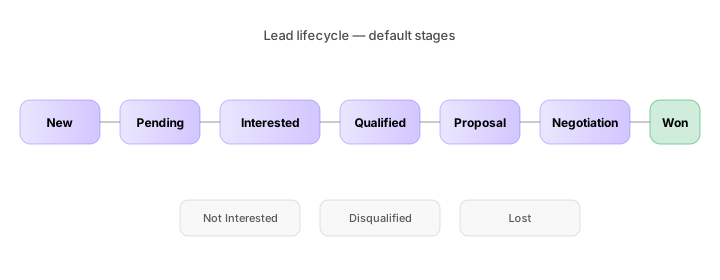
- A deal that's seen no outbound contact in 3 days turns amber.
- A deal that's seen no outbound contact in 6 days turns red.
- A deal with no inbound or outbound activity in 14 days gets flagged as "at risk of being a polite no."
- A deal that's been in the same stage for 30+ days without any progress signal gets surfaced to the founder's brief.
The colour isn't punitive. The colour is information. It is the answer to the question that nobody asks at the lying meeting: "How long has it actually been since we talked to them?"
When Rohan opened thola on a Friday morning two weeks after his team migrated, the pipeline view told him this: of his 38 active deals, 14 had not been contacted in more than 7 days. Of those 14, 6 had not been contacted in more than 14 days. Three of the 6 had been in his pipeline for more than 60 days.
This was the moment when Rohan, who is a calm man, said something we have not transcribed.
What "doing something" looks like
Here is the part that matters more than the visibility — what happens after the colour shows up.
Rohan went through the 14 deals in about forty minutes. For each one, the Sales agent had drafted a next-action. Three options, every time:
-
A polite re-engagement message, drafted in the rep's voice, calling out the silence honestly without being pushy. ("Hi Karthik, it's been about three weeks since we last spoke about XYZ — wanted to check in. Is this still on the table or should I close it out for now?")
-
A "qualify out" suggestion with a one-line rationale. ("This account has been silent for 6 weeks, didn't respond to two prior nudges, and the original inquiry was from a junior. Recommend marking as cold and reassigning the rep's attention.")
-
A "blocker on our side" tag with the specific unanswered question highlighted. ("Acme asked on April 12 about a 6-month pilot. We never answered. Want to send a pilot proposal now?")
Rohan went through the 14 deals. He sent 9 re-engagement messages (3 of those came back into active conversation within 48 hours, one of them closed two weeks later for ₹6.4 lakh). He qualified out 3. He fixed an unanswered question on 2.
The total time was 40 minutes. The number of "deals that were lying" went from 14 to 0 in one Friday morning.
His weekly review that following Wednesday lasted 22 minutes. Previously, the review took 90.
The deeper thing the colour exposes
There's a quieter story underneath the deals.
When Rohan reviewed who had the most aged deals, the colour told him something his team had not told him: one of his four reps had aged deals at three times the rate of the other three. Not because he was bad. Because his pipeline had a higher proportion of large, slow B2B accounts, and his follow-up rhythm hadn't adjusted to them.
This is a coaching conversation, not a firing conversation. But it is a conversation Rohan would not have had without the data — because in the lying meeting, every rep's deals look superficially similar.
The research on this is unambiguous. Sales managers with real-time activity visibility coach 3× more often, and their reps close 23% higher. This is not a feature. It's a behaviour change downstream of having the right data in front of you.
A small note on AI not running your sales
We get asked, often, whether the system "closes deals for you." We do not. We don't pretend to. The agent drafts, the human sends. The agent suggests qualifying out, the human decides. The agent points at the blocker on your side, the human unblocks it.
This is a deliberate choice. Customer-facing actions — especially in a culture where the relationship is the deal — should not be auto-sent by software. The best sales motions in this market are still built on the trust between humans. The job of the system is to make sure the human is the one with the right context, at the right moment, with the right draft already prepared.
When an agent makes one of these suggestions, you can see why. A one-line rationale comes attached — "this account has been silent for 6 weeks and didn't respond to two prior nudges" — and you can disagree with the rationale and override the suggestion. The measurable part (the aging, the silence, the activity counts) is rock-solid. The interpretive part (was this a polite no, was this a procurement delay, was this our fault) is the rep's call.
What it looks like a quarter later
Rohan's pipeline three months in:
- The same 38-deal pipeline became a 41-deal pipeline. Slight growth, fine.
- The stuck deal count — deals with no activity in 14+ days — went from 14 to typically 1 or 2 at any given moment, with a hard ceiling of 4.
- The won-from-stuck rate — deals that re-engaged and eventually closed after being flagged — was around 18% over the quarter. Roughly ₹14 lakh of revenue that was, in his words, "already on the floor; we just hadn't picked it up."
- The weekly review went from 90 minutes of "what about this deal" to 25 minutes of "what about this pattern."
The deeper change is the one Rohan wrote in a customer interview: "I stopped having a private theory of who's actually selling. I now know."
What we're not pretending to do
A few honest limits:
- B2B deal forecasting with probabilistic close-date prediction is not yet shipped. We aged deals and surface qualification suggestions; we don't yet predict close probabilities. (Conservative forecasts work today; probabilistic ones are on the roadmap.)
- Behavioural churn prediction for existing customers — separate from this aging-deals story — is not yet shipped either. We do revenue-based churn, not behavioural.
- Multi-channel ecommerce sync (Shopify, WooCommerce) is planned, not shipped. If your pipeline includes online stores, the offline / B2B side is handled cleanly; the online side is on the way.
- The aging thresholds aren't yet user-configurable. 3-day amber and 6-day red are the defaults. If your business cycle is months, not weeks, the configurability is on the roadmap.
Get started
If you want to see how many deals are quietly aged in your current pipeline, the CRM lead-management guide walks through the migration. Most teams find their first batch of dead deals inside the first day.
It is uncomfortable. It is also the difference between a quarter that lands and a quarter that surprises you.
Related posts
WhatsApp is your CRM — and that's the problem.
A founder-to-founder look at why pipeline-in-WhatsApp leaks 3–5% of revenue every year, and how to fix it without asking your team to switch chat apps.
Cash control that fits your shop.
A solo owner, a family helper, and a four-counter supermarket need three different kinds of cash discipline. Here's how one setting scales across all of them — and why the day-close should reassure you, not accuse anyone.
Catching cashflow trouble three weeks earlier.
Most founders learn they have a cash problem on the Sunday they update the runway sheet. Here's what the same problem looks like when you see it the day it starts.