
The Monday morning that doesn't start with a spreadsheet.
2026-05-19 · 9 min read · by the thola team
It is 7:14 AM on a Monday and Ananya is at her kitchen table with three open laptops.
The first one has the master P&L sheet — fourteen tabs, named with the kind of optimism that always ends in a number and the words "FINAL USE THIS ONE." The second one is open to a Google Drive folder of 800 PDFs, mostly bills, some of which she'll reconcile this afternoon, some of which she will not because life is finite. The third has her email, into which her bookkeeper is currently asking a question about an invoice from March that nobody can find.
Ananya runs a 14-person product-design studio in Bangalore. She has not had a calm Monday morning in three years.
What she will do over the next four hours, before her first client call at 11 AM, is read her business. Pipeline this week (from a sheet that gets updated once a week, by hand). Cash position (from a different sheet, by hand). Project margins (from a third sheet, also by hand). Team capacity (in someone's head, ideally hers, somewhat in Slack). HR exceptions (a WhatsApp thread).
She will end the four hours not particularly clear on anything, slightly behind on email, and aware that the first decision she makes today will be made from numbers that are between three days and three weeks stale.
This is the most expensive form of work in early-stage Indian business. It has no line item on the P&L. The people who do it cannot articulate it, because they have always done it, because every founder they know does it. It is the founder as integration layer, and it is the single highest-leverage thing to remove.
Why dashboards didn't fix this
The conventional answer is "you need a dashboard." Ananya already tried that. She had a BI tool that her former co-founder set up in 2024. It had eleven charts. She opened it twice, once on the demo and once during onboarding, and then she stopped.
The reason a dashboard didn't fix her Monday is that a dashboard assumes the person reading it knows which numbers matter, what a normal range looks like, and what to do about an abnormal one. For a Head of Ops at a 200-person company, that's a fair set of assumptions. For Ananya, alone at her kitchen table with chai, three of those four things are missing.
Ananya doesn't need eleven charts. She needs three sentences that end in verbs.
What replaces the spreadsheet ritual
Here's what Monday morning looks like for Ananya now, four weeks into thola.
It is 7:14 AM. She has one laptop and one cup of tea. She opens the home page.
What she sees is not a chart. It's a brief. Three sections, in this order:
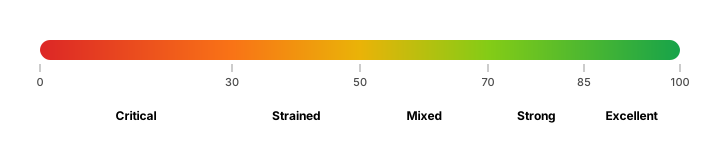
1. Health of the five pillars
A weekly score, from 0 to 100, on each of: Sales, Finance, Team, Process, Founder. Not a vanity number. A score computed from underlying signals: pipeline aging, follow-up rate, cash position, days-to-collect, payroll exceptions, project on-budget rate, scope-creep flags, founder-focus signals (how much of her time last week went to wrong-stage work).
The score is useful because it has two-week directionality. If Sales went from 72 to 65, she knows. The 65 isn't the story. The drop is the story.
Each pillar has 2–3 specific red-flag triggers attached. For Sales last week: "Five leads are now in the 'no contact in 7+ days' bucket. The biggest is Ramesh Industries — ₹2.8L estimated value." That's not a chart. That's a sentence she can act on.
2. The three things to do today
The brief picks three actions for the day. Today, for Ananya:
- "Karthik's pitch deck to Innov8 is due tomorrow. He hasn't checked in the draft yet. Send him a nudge?" (one-tap nudge button)
- "Two invoices from April aged past 60 days. ₹3.4L total. Drafted polite reminders for both — review and send?" (one-tap review)
- "Two new candidates applied for the senior designer role. Want me to schedule first calls?" (one-tap schedule)
This list isn't AI making decisions for her. It's the brief telling her, in plain language, what the three highest-leverage actions she has today are. She does them in fourteen minutes. Or she ignores them and does what she planned. Either way, she's not navigating across four tools to find them.
3. The diagnostic, when something's wrong
If something's off — a key client is going quiet, payroll is going to overrun next month, two projects are running over budget at once — there's a red flag at the top of the brief with a one-line description and a "tell me more" tap.
The red flag opens a chat. Not a settings page. A chat. "Two projects, Innov8 and Reema Studios, both crossed 110% of budget last week. Innov8 is on track to land at 124%. Reema is recoverable. Want to see what's driving Innov8?" She taps yes. The system explains. She decides what to do.
This is the entire ritual. Eight to twelve minutes, depending on whether anything's actually broken.
What's underneath the brief
For the curious, briefly: the brief isn't a chart hiding behind text. It's computed from the live state of every module — sales, finance, team, projects, POS — as of the last few hours. The five-pillar score refreshes every six hours. The red flags refresh on the same cadence. The three daily actions are picked fresh every morning from the pool of pending tasks, aged leads, overdue invoices, and approval queues.
What it isn't: a static page. Or a chart engine. Or a separate "reporting tool" you have to set up. It's a side effect of running the rest of your business inside thola — which we'd argue is the only honest way to build a founder dashboard. A dashboard sourced from a tool you don't use is a dashboard nobody trusts.
The thing that surprised Ananya
When we sat down with her at the end of week three to ask what had actually changed, she said something we did not expect.
She didn't say "I save four hours on Monday." She said it that way too, but it wasn't the headline. What she said was:
"I sleep on Sundays now. I didn't know I wasn't sleeping on Sundays. I just thought that was Sundays."
This is the un-pitched benefit, and it is the real one. Founders have been carrying their business in their heads on Sundays because they don't trust the spreadsheets to be true, and they don't have any other source of truth. When the brief lands at 7 AM Monday and the picture is honest, you don't have to carry it around at 9 PM Sunday.
The hour saved is real. The Sunday sleep is the thing she'll tell other founders about.
The shape of the deeper change
There is a particular pattern in how founders go from "I have a tool" to "I have a system" and it goes through three stages.
Stage 1 — the data is in. You connect bank, sales pipeline, projects, team, payroll. The numbers are now somewhere other than spreadsheets. This is week one. You feel mild relief.
Stage 2 — the brief becomes load-bearing. You start checking the morning brief before you check email. This is roughly week two. The brief replaces the "scan five tabs" ritual. You stop opening Sheets.
Stage 3 — you delegate the integration layer. This is the one nobody talks about. You stop being the human bridge between WhatsApp leads and the CRM, between project updates and the finance sheet, between payroll exceptions and the bank file. The system does the bridging. You do the deciding. This usually shows up around week four to six, and it is the point at which founders tell us they couldn't go back.
The first two stages are about data. The third stage is about identity. You stop being the manager of the manager of the manager, and you start being the thing only the founder can be — the person who decides the shape of the business.
Why this isn't a chatbot strapped to a dashboard
A lot of products in this space are starting to look superficially similar — a chat box, some charts, an "AI brief." We'd be lying if we said the screens don't share genes.
The difference is what's connected behind the chat. If the only thing the chat can read is a static dataset you uploaded, you are looking at a chatbot bolted to a notebook. If the only thing it can do is draw charts, you are looking at a charting library with a microphone.
What you want is a chat that's connected to the live state of your business — pipeline, cash, payroll, projects, customers, team — and that can not only answer ("what's our cash position?") but also act ("draft reminders for the three overdue invoices and pause until I review them"). That's the bar.
We are not the only company aiming at that bar. We are one of a handful. The bar matters more than the brand.
What we're not pretending to do
A few honest limits:
- Custom KPIs beyond the five pillars aren't a feature yet. If you want a sixth pillar — "Customer success score" — you can't build it visually today. We're getting there.
- Public competitor benchmarking — "you're at score 72 on Sales, your peer cohort is at 78" — is on the roadmap. We have internal cohort data, but the public-facing version is planned.
- Slack and Microsoft Teams notifications for the morning brief are partial. WhatsApp and email work today.
- The brief is opinionated. If you don't agree with the three actions it picks, you can ignore them. We don't yet have a "show me different actions" picker.
Get started
If you want to retire the master sheet, start by connecting two modules — Finance and Projects, for most service businesses — and let the brief begin to compute. The getting-started guide walks through it. Most founders are at the first useful brief inside two days.
There is a strange feeling, the first Monday you open the brief and there is nothing red. We hope you get there.
Related posts
thola is not a dashboard.
Why we built an agent operating system instead of yet another business-intelligence tool — and what changes when chat is the steering wheel, not a side feature.
Cash control that fits your shop.
A solo owner, a family helper, and a four-counter supermarket need three different kinds of cash discipline. Here's how one setting scales across all of them — and why the day-close should reassure you, not accuse anyone.
Catching cashflow trouble three weeks earlier.
Most founders learn they have a cash problem on the Sunday they update the runway sheet. Here's what the same problem looks like when you see it the day it starts.