
WhatsApp is your CRM — and that's the problem.
2026-05-19 · 9 min read · by the thola team
It is 11:14 on a Friday morning and Priya is staring at three WhatsApp screens at once.
She runs a 14-person interior-design studio out of HSR Layout in Bangalore. Her phone has the studio's main number. Her partner Ananya's phone has the showroom number. Their senior designer Karthik's phone has the "Bangalore Project Enquiries" group, which has 87 members and has been muted for nine months.
Somewhere in those three phones is a lead from a customer named Mrs. Rao. Mrs. Rao asked for a quote on a 3BHK in Whitefield two weeks ago. Karthik sent her a brochure, Priya sent her a designer's profile, and Ananya forwarded a photo of a recent project. Then Mrs. Rao went quiet. None of them realised she was waiting for someone to send her the quote — because each of them assumed the other was on it.
Mrs. Rao is going to sign with a competitor next Tuesday. Priya doesn't know that yet. She also doesn't know there are six other Mrs. Raos in her phone right now.
The number that should scare you
Here is the headline finding from the most recent SMB sales survey we trust: 72% of salespeople say they lose deals due to poor follow-up systems, not poor fit. Not "the customer didn't want it." Not "we were too expensive." A systems failure — somebody on the team didn't make the third or fourth call, and the lead went cold.
That number translates uncomfortably for a business like Priya's. A typical B2B Indian SME with ₹10 crore in revenue leaks ₹30–50 lakh a year to follow-up failure. The leakage rate is 3–5% of revenue, every year, and it doesn't show up on any P&L because the deals never get booked in the first place.
Eighty-seven percent of Indian SMB customer interactions now happen on WhatsApp. WhatsApp is a brilliant messaging app. It is a catastrophic CRM. There is no pipeline view, no aging filter, no "leads you haven't replied to in five days," no audit trail of who said what to whom. If you lose your phone, you lose your business memory.
This is what tool sprawl with no source of truth feels like in practice. Your leads are in WhatsApp. Your customers are in Tally. Your projects are in Excel. Nothing reconciles. You are the integration layer, and you go to bed every night carrying the entire pipeline in your head.
The mistake everyone makes when they "fix" this
The standard fix is to tell the team: "From Monday, log every lead in the CRM."
This fails inside two weeks. Predictably. We've watched it fail dozens of times. The reason is simple — your team is talking to customers in WhatsApp because customers are in WhatsApp. Asking your team to first reply in WhatsApp and then go log a copy in another tool is asking them to do double work, which they will stop doing on the first busy Tuesday.
The right shape of the fix is the opposite. Keep your team in WhatsApp. Let a system watch.
What changes with thola
When Priya signed up for thola, she gave it her studio's WhatsApp Business number and three things happened.
-
Every new conversation becomes a lead profile. Mrs. Rao messaged the studio number on April 28. By April 28 at 4:11 PM, there was a customer profile for her in thola — name (pulled from her WhatsApp display name), phone, the property she mentioned, and the brochure Karthik sent her. Nobody typed any of this into a CRM. It came from the conversation.
-
The lead got assigned to a real human, automatically. thola's CRM looked at who's online, who's handled Whitefield enquiries before, who's at workload capacity. It picked Karthik. Karthik got a notification: "New Whitefield enquiry — Mrs. Rao — owner has 3BHK to be done by June." Karthik also got a one-line reason for why it landed with him — "closest fit on Whitefield + 2 open enquiries, balanced load" — so the assignment didn't feel like a black box.
-
The lead has a clock now. Every lead in thola has an aging counter. After 3 days with no outbound contact, it turns amber. After 6 days, red. Mrs. Rao would have showed red on May 4. Priya would have seen it on her morning brief at 9 AM. Karthik would have got a nudge in his own queue: "Mrs. Rao — aged 6 days — last touch was the brochure. Send the quote?"
You don't need to know the words "pipeline" or "stage." You don't pick from a menu of CRM statuses. You just see a list of conversations the studio is currently in, sorted by which ones are about to leak.
The user-side flow, in 5 steps
Here is what it actually looks like for Priya, the day she set this up:
- Connect the studio's WhatsApp Business number once. A QR code, ninety seconds. The team keeps replying from their normal WhatsApp.
- Tell thola who handles what. A simple sentence: "Karthik does Whitefield and Sarjapur. Reema does HSR and Indiranagar. Anyone can take walk-ins." That's the routing rule. No drop-downs, no role-fit matrices.
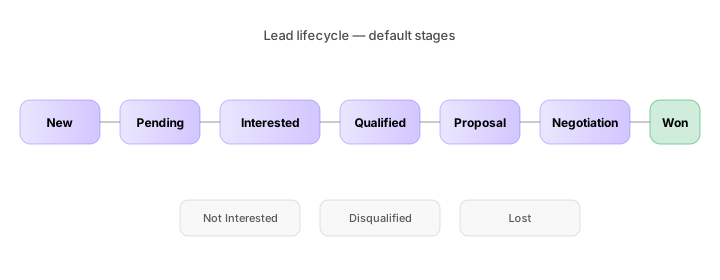
- Open the studio dashboard tomorrow morning. Every lead from the last 48 hours is there with an assignee, a last-touch timestamp, and a stage (new, quoted, site-visit-done, won, lost).
- Scroll to "Needs follow-up today." Five names. Each one tells you why it's there — "no reply in 4 days," "site visit done but no quote," "quote sent but no payment."
- Tap one. The full WhatsApp thread is right there. Karthik's brochure, Ananya's photo, the silence. A one-tap suggested reply is drafted in the studio's voice. Priya can edit, send, or hand it back to Karthik.
That's it. There is no "data entry." The conversations stay in WhatsApp. thola simply makes the pipeline that was always implicit, finally visible.
What it looks like a week later
A real number from a real customer (a 22-person events agency in Pune, three months in): in the first week of using thola, they identified 14 leads that had gone cold for more than 7 days. They followed up on 11 of them — the other 3 had already signed elsewhere. Of the 11, four came back into active conversation. One of those four became a ₹6.2 lakh booking.
That's one week. ₹6.2 lakh of revenue that was already sitting in their WhatsApp threads, that nobody on the team could see, because there was no view of it.
For Priya's studio, after three weeks: the studio went from "we follow up when we remember" to "we have 18 active leads, 5 of them are amber, 1 is red, and Karthik is on the red one this morning." She still couldn't tell you exactly which deal will close — nobody can. But she could tell you which deals were about to leak, and she had time to do something about it.
That's the difference.
What we're not pretending to do
A few honest limits, because we'd rather you hear them from us:
- We don't replace WhatsApp. We sit alongside it. Your team's replies still go out from WhatsApp. We're the memory and the visibility, not the messaging app.
- We don't auto-send messages to customers without sign-off. Drafts come pre-written, but a human taps send. Especially in the first month, when the tone needs to feel right.
- Behavioural churn prediction is not yet a feature here. We can tell you a lead has aged. We can't yet tell you a customer is behaviourally about to churn before they signal it. That's on the roadmap, not in the product today.
- Pipeline forecasting beyond 60 days is conservative by default. If you want a more aggressive forecast, you can ask the assistant to switch it.
We say this up front because the SMB software market is full of vendors who oversell. We'd rather you sign up because the feature you need today actually works today.
The bigger shift
There is a deeper thing going on here, and it's worth saying out loud.
The pain isn't "we need a CRM." Plenty of founders have tried a CRM, and the team stopped logging into it inside a month. The pain is that the founder is the integration layer between WhatsApp and the rest of the business. Priya holds the pipeline in her head. So does Ananya. So does every founder of every services business in this country.
The job of a tool like thola isn't to give you a better dashboard. It's to take the integration layer out of your head and put it in software, so you can stop carrying it home on Friday evening.
When that happens, Sunday-night dread goes away. Not because you have fewer problems — you have the same problems — but because the problems are now things you can see, and seeing is most of the work.
Get started
If you want to wire your studio's WhatsApp Business number to thola, the five-minute walkthrough is in the CRM lead-management guide. The free tier handles up to 200 active leads and full pipeline visibility; you can run an entire 14-person services business on it before you ever upgrade.
Priya did. So can you.
Related posts
Stuck deals are not a sales problem.
When a deal sits for 21 days with no movement, the team will tell you "the customer is thinking." The data tells you something else entirely.
Cash control that fits your shop.
A solo owner, a family helper, and a four-counter supermarket need three different kinds of cash discipline. Here's how one setting scales across all of them — and why the day-close should reassure you, not accuse anyone.
Catching cashflow trouble three weeks earlier.
Most founders learn they have a cash problem on the Sunday they update the runway sheet. Here's what the same problem looks like when you see it the day it starts.